
Understanding Vocal Shifts and Hormonal Aging
We often talk about how aging affects our skin, joints, and energy levels, but we rarely discuss the “sound” of aging. Your voice is a finely tuned instrument, powered by a complex interplay of muscles, cartilage, and delicate mucosal tissue. Just as a violin’s wood might change with the seasons, your vocal folds—the two bands of muscle in your larynx—react to the shifting hormonal tides of your body.
If you have noticed that your voice feels “thinner,” your pitch has shifted, or you simply tire out after a long conversation, you aren’t just “getting older.” You are experiencing the physiological impact of hormonal transitions. Whether it is the drop in estrogen during menopause or the gradual decline of testosterone in men, these chemical signals dictate the health and vibration of your voice.
The Science of the Sound: Why Hormones Matter
To understand why our voices change, we first have to look at the anatomy of the larynx. The vocal folds are covered in a specialized layer called the lamina propria. This area is rich in proteins like collagen (for strength), elastin (for stretch), and hyaluronic acid (for hydration).
Hormones like estrogen and testosterone act as “maintenance workers” for this tissue. When these hormone levels are high, the vocal folds remain plump, hydrated, and flexible. When they drop, the “maintenance” slows down. The result is a shift in how the vocal folds vibrate, which directly changes the sound the world hears.
The Female Voice: Navigating Menopause
For women, the most significant shift occurs during the perimenopausal and postmenopausal years. This is a period marked by a sharp decline in estrogen and progesterone. In the world of speech-language pathology, we sometimes refer to the resulting symptoms as Menopausal Laryngopathy.
Key Changes in the Postmenopausal Voice
Pitch Lowering: As estrogen levels drop, the vocal folds may become slightly more edematous (swollen) or, conversely, undergo atrophy. For many women, this results in a permanently lower speaking pitch.
Reduced Range: Singers often notice this first. The high notes that used to feel effortless now require significant strain or have disappeared entirely.
Vocal Fatigue: You might find that your voice “gives out” by the end of a dinner party or a long work day.
Dryness: Estrogen helps maintain the mucosal lining of the throat. Without it, the vocal folds can feel “sticky” or dry, leading to a constant need to clear the throat.
An Anecdote: Sarah’s Story
Take “Sarah,” a 52-year-old high school teacher and choir member I recently worked with. Sarah noticed that her “calling voice”—the one she used to command a classroom—felt scratchy and weak. In choir, she found herself shifting from a soprano to an alto because her top notes felt “tight.” By understanding that her vocal folds were losing their natural hydration and elasticity due to menopause, we were able to implement specific resonance exercises to help her find power without the strain.
The Male Voice: The Impact of Andropause
Men also experience hormonal aging, though it is often more gradual. This is sometimes called Andropause. As testosterone levels decline, the primary muscle of the vocal fold (the thyroarytenoid muscle) can begin to lose mass, a process known as sarcopenia.
Key Changes in the Aging Male Voice
Pitch Elevation: Unlike women, whose voices often get lower, men’s voices frequently get higher as they age. This happens because the vocal folds thin out and lose mass, vibrating faster—much like the thin strings on a guitar.
Loss of Projection: Because the vocal folds are thinner and may not close completely (a condition called “bowing”), air escapes during speech. This makes the voice sound breathy or weak.
The “Wavering” Sound: A loss of muscle tone can lead to a slight tremor or instability in the voice, making it harder to sound authoritative.
Comparison: Male vs. Female Vocal Aging
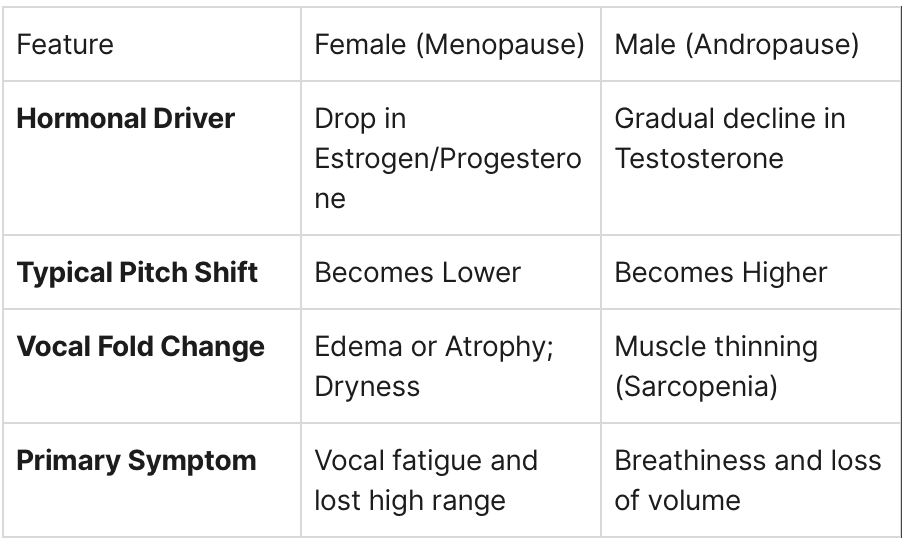
Presbyphonia: The Clinical Reality
Regardless of gender, the general medical term for an “aging voice” is Presbyphonia. This is the collective result of hormonal shifts, reduced lung capacity, and the calcification of the laryngeal cartilages.
Think of your voice like a professional athlete. In your 20s, you could “sprint” (scream at a concert or talk for eight hours) without a second thought. As you enter your 50s, 60s, and beyond, your vocal “muscles” require a better warm-up and more intentional recovery. The “athlete” is still there, but the training regimen must change.
How to Protect Your Voice in 2026
The good news is that your voice is highly responsive to therapy and lifestyle adjustments. As we move through 2026, new research continues to show that “voice fitness” is just as important as physical fitness.
1. Hydration is Non-Negotiable
Your vocal folds need systemic hydration to vibrate efficiently. If you are experiencing menopausal dryness, drinking plenty of water and using a personal steamer (nebulizer) can provide direct relief to the tissue.
2. Professional Voice Therapy
Evidence-based programs like PhoRTE (Phonation Resistance Training Exercises) or VFE (Vocal Function Exercises) are designed specifically to “bulk up” aging vocal folds. These are like “weightlifting for your throat” and can help close the gap caused by hormonal thinning.
3. Resonance Training
Learning to “place” your voice in the mask of your face (resonance) reduces the workload on your actual vocal folds. This is the secret to sounding powerful without feeling tired.
4. Consult the Experts
If your voice has changed significantly, it is important to see a Laryngologist (an ENT who specializes in voice) and a Speech-Language Pathologist. They can examine your vocal folds with a tiny camera (stroboscopy) to see exactly how your hormones affect your vibration.
Final Thoughts: Own Your Sound
Your voice is your identity. It carries your history, your emotions, and your authority. While hormonal changes are an inevitable part of the human experience, a “weak” or “old” voice doesn’t have to be. By understanding the science of how estrogen and testosterone maintain our vocal health, we can take proactive steps to keep our instruments in peak performing condition for years to come.
If you are in the Guelph area or looking for virtual support, don’t hesitate to reach out. Your voice has a lot more to say—let’s make sure it’s heard clearly.
